
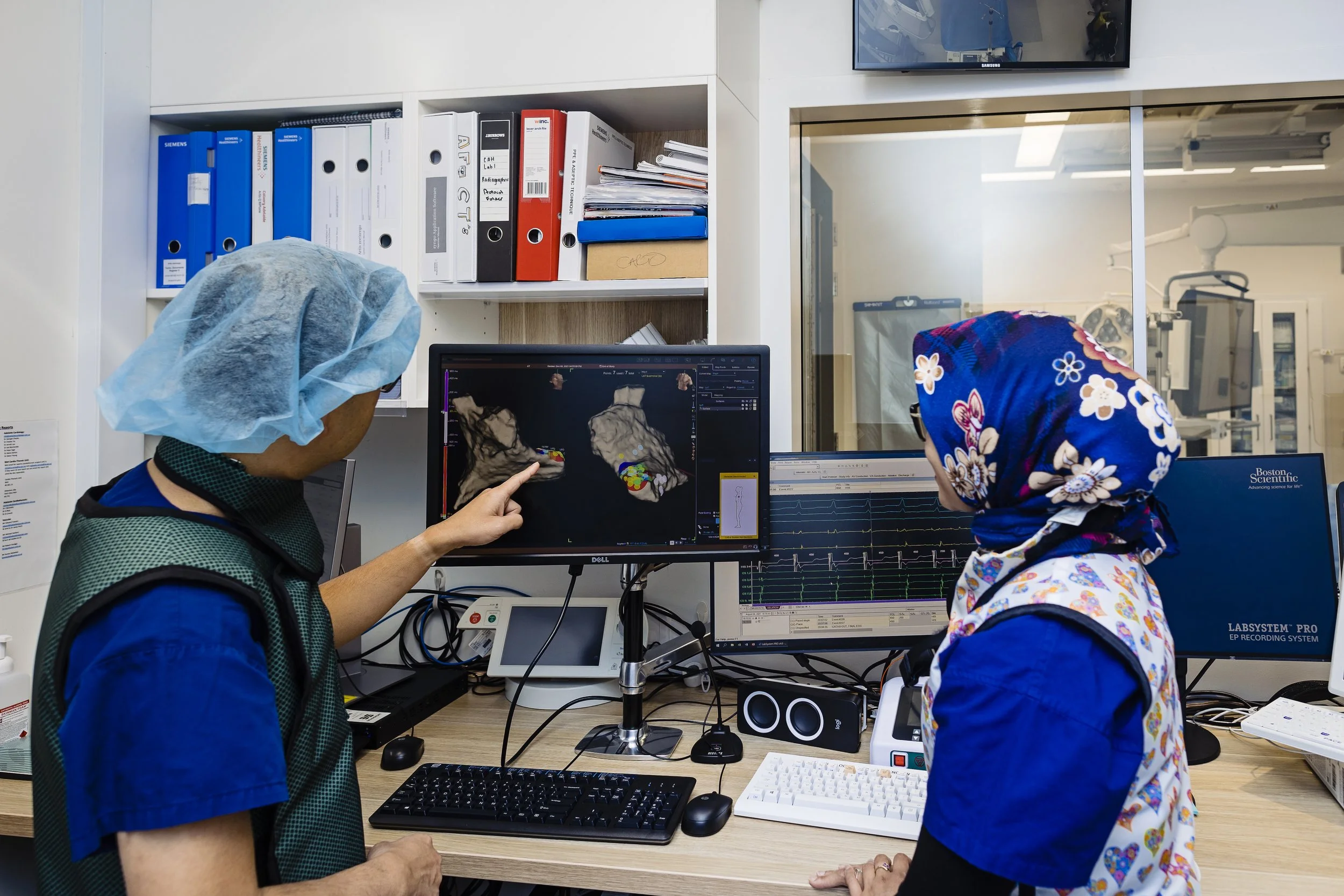
Procedures
We offer a range of specialist cardiology procedures performed by our doctors in a hospital setting. If a procedure is recommended, our team will coordinate your hospital booking and guide you through the process. If you have any questions or to learn more, please contact the practice to speak to our friendly reception team.
-
An AF Ablation is a procedure used to treat atrial fibrillation (AF), an irregular heart rhythm arising from the upper chambers of the heart. During the procedure, specialised catheters are guided into the heart to identify and treat the abnormal electrical signals causing the arrhythmia. The aim is to restore and maintain a more regular heart rhythm, improve symptoms, and reduce episodes of AF.
To learn more about this procedure, please contact the practice to speak with one of our team members or request a patient information sheet.
-
An AV Junction Ablation is a procedure used to control fast or irregular heart rhythms by interrupting abnormal electrical signals travelling between the upper and lower chambers of the heart. The procedure is most commonly performed in patients with atrial fibrillation when medications or other treatments have not been effective. Following the procedure, a permanent pacemaker is required to maintain an appropriate heart rate.
To learn more about this procedure, please contact the practice to speak with one of our team members or request a patient information sheet.
-
An AV Node Ablation is a procedure used to treat certain fast or irregular heart rhythms by deliberately blocking electrical conduction through the heart’s AV node. It is commonly performed for patients with atrial fibrillation who continue to experience symptoms despite medication or other rhythm-control treatments. A permanent pacemaker is required following the procedure to regulate the heart rhythm.
To learn more about this procedure, please contact the practice to speak with one of our team members or request a patient information sheet.
-
A Battery Change, also known as a generator replacement, is a procedure performed to replace the main device component of an existing pacemaker, ICD, or CRT device once the battery becomes low. The existing leads usually remain in place, while the old generator is disconnected and replaced with a new device to ensure ongoing heart rhythm management and device function.
To learn more about this procedure, please contact the practice to speak with one of our team members or request a patient information sheet.
-
A Cardioversion is a procedure used to restore a normal heart rhythm using a controlled electrical shock delivered to the heart. It is commonly performed for abnormal heart rhythms such as atrial fibrillation or atrial flutter. The aim of the procedure is to reset the heart’s electrical system and improve symptoms related to an irregular heartbeat.
To learn more about this procedure, please contact the practice to speak with one of our team members or request a patient information sheet.
-
A CRT Implant (Cardiac Resynchronisation Therapy) is a specialised cardiac device implanted to help improve the coordination and pumping function of the heart. The device uses leads positioned within the heart to help the chambers beat in a more synchronised and efficient way. CRT devices are commonly used in patients with heart failure and electrical conduction abnormalities.
To learn more about this procedure, please contact the practice to speak with one of our team members or request a patient information sheet.
-
An Electrophysiology (EP) Study is a procedure used to assess the heart’s electrical system and investigate abnormal heart rhythms. Thin catheters are guided into the heart to record electrical activity and identify the source of arrhythmias. In some cases, treatment such as catheter ablation may also be performed during the same procedure.
To learn more about this procedure, please contact the practice to speak with one of our team members or request a patient information sheet.
-
A Flutter Ablation is a procedure used to treat atrial flutter, an abnormal heart rhythm arising from the upper chambers of the heart. During the procedure, catheters are guided into the heart to identify and treat the abnormal electrical circuit responsible for the arrhythmia. The aim is to restore a more regular heart rhythm and reduce future episodes of atrial flutter.
To learn more about this procedure, please contact the practice to speak with one of our team members or request a patient information sheet.
-
A Loop Recorder Implant is a minor procedure involving the insertion of a small cardiac monitoring device beneath the skin of the chest to continuously record the heart rhythm over an extended period. It is commonly used to investigate unexplained symptoms such as palpitations, dizziness, or blackouts. An explant refers to the removal of the device once monitoring is complete or no longer required.
To learn more about this procedure, please contact the practice to speak with one of our team members or request a patient information sheet.
-
A Pacemaker Implant is a procedure involving the insertion of a small electronic device designed to help regulate the heart’s rhythm. The pacemaker monitors the heart rate and delivers electrical impulses when required to maintain an appropriate heart rhythm. Pacemakers are commonly used to treat slow heart rates or electrical conduction abnormalities within the heart.
To learn more about this procedure, please contact the practice to speak with one of our team members or request a patient information sheet.
-
An ICD Implant (Implantable Cardioverter Defibrillator) is a procedure involving the insertion of a specialised cardiac device designed to monitor and treat dangerous heart rhythms. The device can deliver pacing or an electrical shock if a life-threatening arrhythmia is detected. ICDs are commonly recommended for patients at increased risk of sudden cardiac arrest or serious ventricular arrhythmias.
To learn more about this procedure, please contact the practice to speak with one of our team members or request a patient information sheet.
-
A PVC Ablation is a procedure used to treat premature ventricular contractions (PVCs), which are extra heartbeats arising from the lower chambers of the heart. During the procedure, catheters are guided into the heart to identify and treat the area responsible for triggering the abnormal beats. The aim is to reduce symptoms, improve heart rhythm stability, and support heart function.
To learn more about this procedure, please contact the practice to speak with one of our team members or request a patient information sheet.
-
An SVT Ablation is a procedure used to treat supraventricular tachycardia (SVT), a condition causing episodes of rapid heart rhythm originating from the upper chambers of the heart or associated electrical pathways. The procedure involves identifying and treating the abnormal electrical pathway responsible for the arrhythmia to help prevent future episodes and improve symptoms.
To learn more about this procedure, please contact the practice to speak with one of our team members or request a patient information sheet.
-
A VT Ablation is a procedure used to treat ventricular tachycardia (VT), a potentially serious fast heart rhythm arising from the lower chambers of the heart. Specialised electrical mapping is used to identify the abnormal areas responsible for the arrhythmia, which are then treated using catheter ablation techniques. The aim is to reduce recurrent VT episodes, improve symptoms, and stabilise the heart rhythm.
To learn more about this procedure, please contact the practice to speak with one of our team members or request a patient information sheet.
Questions About a Procedure?
If you have been advised to undergo a procedure or would like further information, please contact our team.
📞 Phone: (08) 8317 5300
✉️ Email: admin@integralhealthcare.com.au

Our team will guide you through each stage of your procedure, including hospital booking, preparation instructions, and follow-up care.